
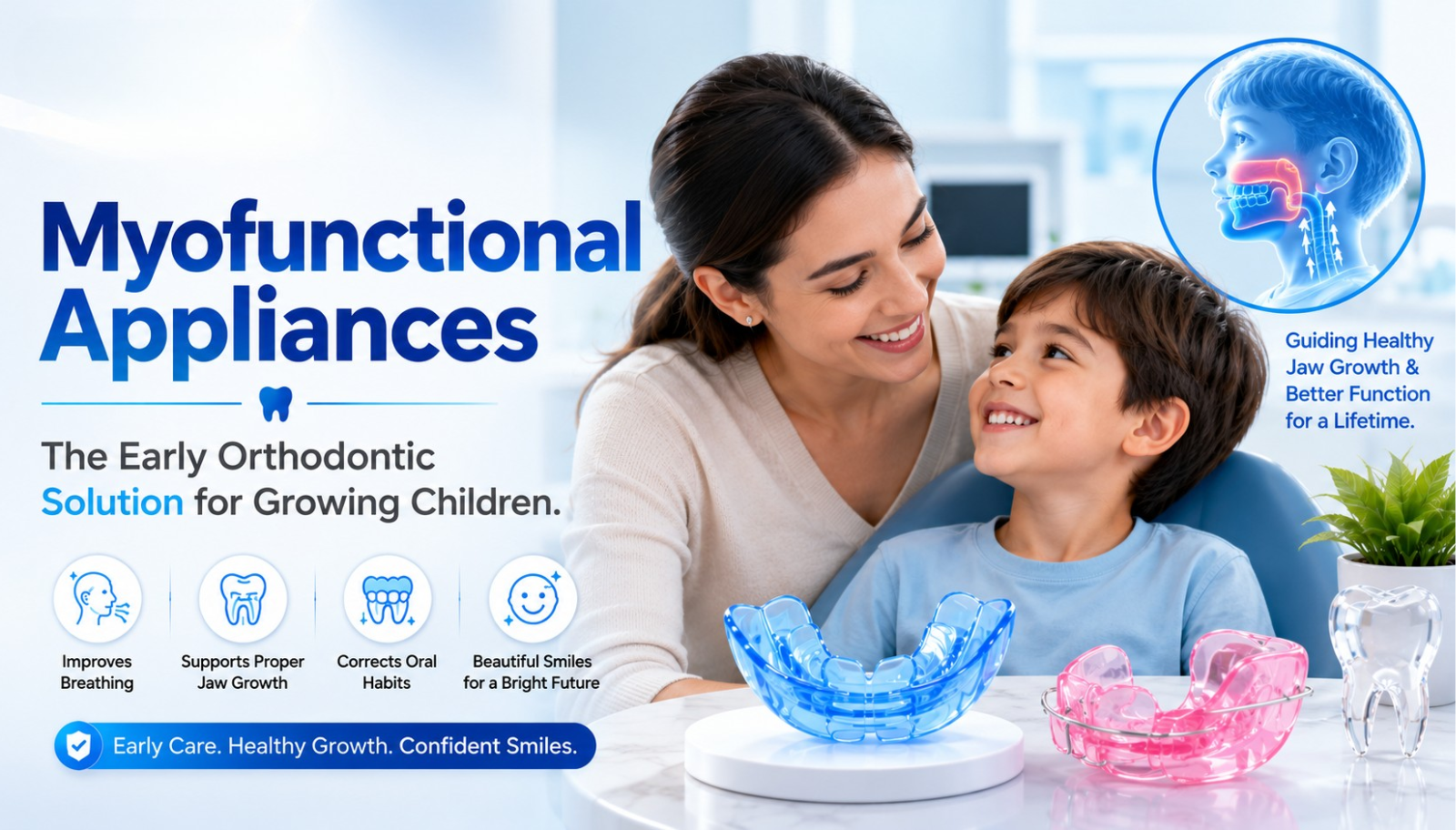
Most parents assume orthodontic treatment begins when a child’s permanent teeth have fully come in. Braces, in the popular imagination, belong to teenagers. But orthodontists increasingly recognise a far more effective window of intervention – one that opens much earlier, while the jawbones and facial structures are still actively developing. Myofunctional appliances work within this window, guiding growth rather than correcting it after the fact.
What Are Myofunctional Appliances?
Myofunctional appliances are removable orthodontic devices designed to correct the relationship between the jaws, teeth, and surrounding muscles during a child’s growth phase. Unlike fixed braces that move individual teeth, myofunctional appliances work at a more foundational level. They redirect how the jaws develop, influence muscle function, and create the skeletal conditions for teeth to erupt into better positions naturally.
The word “myofunctional” combines myo (muscle) and functional, reflecting the core principle behind these devices. Crooked teeth and bite problems rarely stem from teeth alone. They often trace back to how the tongue rests in the mouth, how a child breathes, and how the muscles of the face function during swallowing, chewing, and at rest. Myofunctional appliances address these root causes rather than the surface symptoms.
Why Timing Matters in Orthodontics
A child’s jaws grow rapidly between the ages of 5 and 12. During this phase, the bones remain malleable and responsive to gentle forces. Orthodontists refer to this period as the window of peak growth modification. Introducing a corrective appliance during these years makes it possible to guide jaw development in a healthier direction with far less force than would be required once growth is complete.
Early intervention at Amaya Dental begins with a thorough clinical assessment to identify jaw discrepancies, airway issues, or muscle dysfunction before they become entrenched problems. The goal is not to rush treatment but to use the child’s own growth process as a therapeutic ally.
Common Problems Myofunctional Appliances Address
Several orthodontic and functional issues respond well to myofunctional treatment in growing children.
Mouth breathing stands among the most common. Children who habitually breathe through the mouth instead of the nose develop narrowed dental arches, longer facial proportions, and a tongue that rests low in the mouth rather than against the palate. Over time, these patterns produce crowding, open bites, and even changes to facial appearance. Myofunctional appliances encourage nasal breathing by positioning the tongue correctly and retraining the oral muscles.
Thumb and finger sucking exerts prolonged pressure on the front teeth and the developing palate. Children who continue these habits beyond age four often develop protruding upper teeth and a high, narrow palate. A myofunctional appliance can intercept the habit while simultaneously correcting the dental and skeletal effects it has caused.
Class II skeletal discrepancies, commonly seen as a receding lower jaw or protruding upper teeth, respond well to growth modification. Devices like the Twin Block, the Herbst appliance, and the Frankel function regulator position the lower jaw forward during growth, stimulating the condylar bone to develop in a more forward position. This type of correction in a child often takes one to two years. In an adult with the same problem, the only option would be surgical jaw correction.
Class III relationships, where the lower jaw protrudes beyond the upper, can also be addressed during the growth phase using reverse-pull face masks combined with palatal expanders to advance the upper jaw.
Crossbites — where some upper teeth sit inside the lower teeth — benefit from rapid palatal expanders that widen the upper arch before the midpalatal suture fuses, typically in the early teens.
Types of Myofunctional Appliances
Orthodontists have a range of appliances to choose from, and the selection depends entirely on the specific problem, the child’s age, and the degree of growth remaining.
The Twin Block appliance uses two separate blocks that interlock when the child bites, holding the lower jaw in a forward position. Children adapt to it quickly, and it can be worn day and night, including during meals. It has a strong track record for correcting Class II problems in growing children.
The Myobrace system takes a different approach, working more directly on the muscular habits driving the problem. It trains the tongue to rest on the palate, encourages nasal breathing, and helps establish correct swallowing patterns. It suits younger children, particularly those in the 5 to 10 age range, where habit correction has the greatest impact.
Palatal expanders, though not strictly myofunctional devices, work hand in hand with them. By widening the upper jaw during growth, they create space for crowded teeth and improve the transverse relationship between upper and lower arches, reducing the need for extractions later.
Headgear and face masks use external orthopaedic forces to redirect jaw growth. While less common today due to the availability of alternative devices, they remain effective in specific situations where significant skeletal correction is needed.
What Parents Should Look For
Parents are often the first to notice the signs that warrant an early orthodontic evaluation. Certain observations should prompt a visit to an orthodontist rather than waiting for the next routine dental check-up.
A child who snores, breathes through the mouth during sleep, grinds teeth at night, or has a noticeably receding chin or protruding upper teeth may benefit from a myofunctional assessment. Persistent thumb sucking after age four, difficulty chewing certain foods, or a jaw that shifts to one side when closing are also indicators worth investigating.
Amaya Dental recommends an initial orthodontic screening around age 7, in line with guidelines from the Indian Orthodontic Society. At this age, a mix of baby and permanent teeth is present, making it possible for a specialist to identify developing bite problems and jaw discrepancies while there is still significant growth remaining.
The Treatment Process at Amaya Dental
Myofunctional treatment at Amaya Dental begins with a detailed assessment that includes clinical examination, dental X-rays, and, where needed, a cephalometric analysis. A lateral cephalogram provides a precise map of the skeletal relationships between the upper and lower jaws, the position of the teeth, and the angle of the facial profile. This analysis guides appliance selection and establishes a clear baseline against which progress can be measured.
Once the appropriate appliance has been selected, the child’s family receives detailed guidance on wearing schedules, hygiene, and what to expect during treatment. Most myofunctional appliances require 12 to 16 hours of daily wear, including during sleep. Regular review appointments, typically every 6 to 8 weeks, allow the orthodontist to monitor skeletal changes and adjust the appliance as needed.
Myofunctional treatment typically occurs in two phases. The first phase focuses on growth modification and habit correction, lasting 12 to 24 months depending on the severity of the problem and the child’s cooperation. A resting phase follows, during which growth continues, and permanent teeth erupt into their improved positions. A second, shorter phase of fixed braces may then be needed to refine tooth alignment. Because the foundational work has already been done, this second phase is often significantly shorter and simpler than it would have been without early intervention.
Benefits Beyond the Smile
The advantages of myofunctional treatment extend well beyond straighter teeth. Correcting a narrow arch improves airway space and can reduce or eliminate sleep-disordered breathing, including mild obstructive sleep apnoea in children. Retraining breathing patterns away from habitual mouth breathing protects the oral environment from the drying and acidic effects that increase cavity risk. Improving jaw posture reduces strain on the temporomandibular joints, lowering the likelihood of TMJ problems in adult life.
Children who complete myofunctional treatment also tend to require less extensive orthodontic intervention as teenagers. Fewer teeth need extraction, treatment duration with fixed braces shortens, and the outcomes tend to be more stable over the long term because the underlying muscle function has been addressed rather than bypassed.
A Foundation Built During Growth
Myofunctional appliances represent one of the clearest examples of why early orthodontic evaluation makes such a significant difference. The forces needed to redirect a growing jaw are gentle and well-tolerated by children. The same corrections attempted in a fully grown adult would require orthognathic surgery.
Catching a skeletal discrepancy, a breathing dysfunction, or a harmful oral habit at age 6 or 7 and addressing it during the growth phase gives children the best possible foundation for a healthy bite, a well-proportioned face, and a confident smile that lasts a lifetime.
If your child shows any signs of jaw imbalance, persistent mouth breathing, crowded teeth, or a bite that doesn’t look quite right, an early orthodontic consultation can clarify whether myofunctional treatment would help. At Amaya Dental, our paediatric dentistry and orthodontic specialists provide thorough growth assessments in a comfortable, child-friendly environment across our Vasanth Nagar and Sahakar Nagar clinics in Bangalore.

