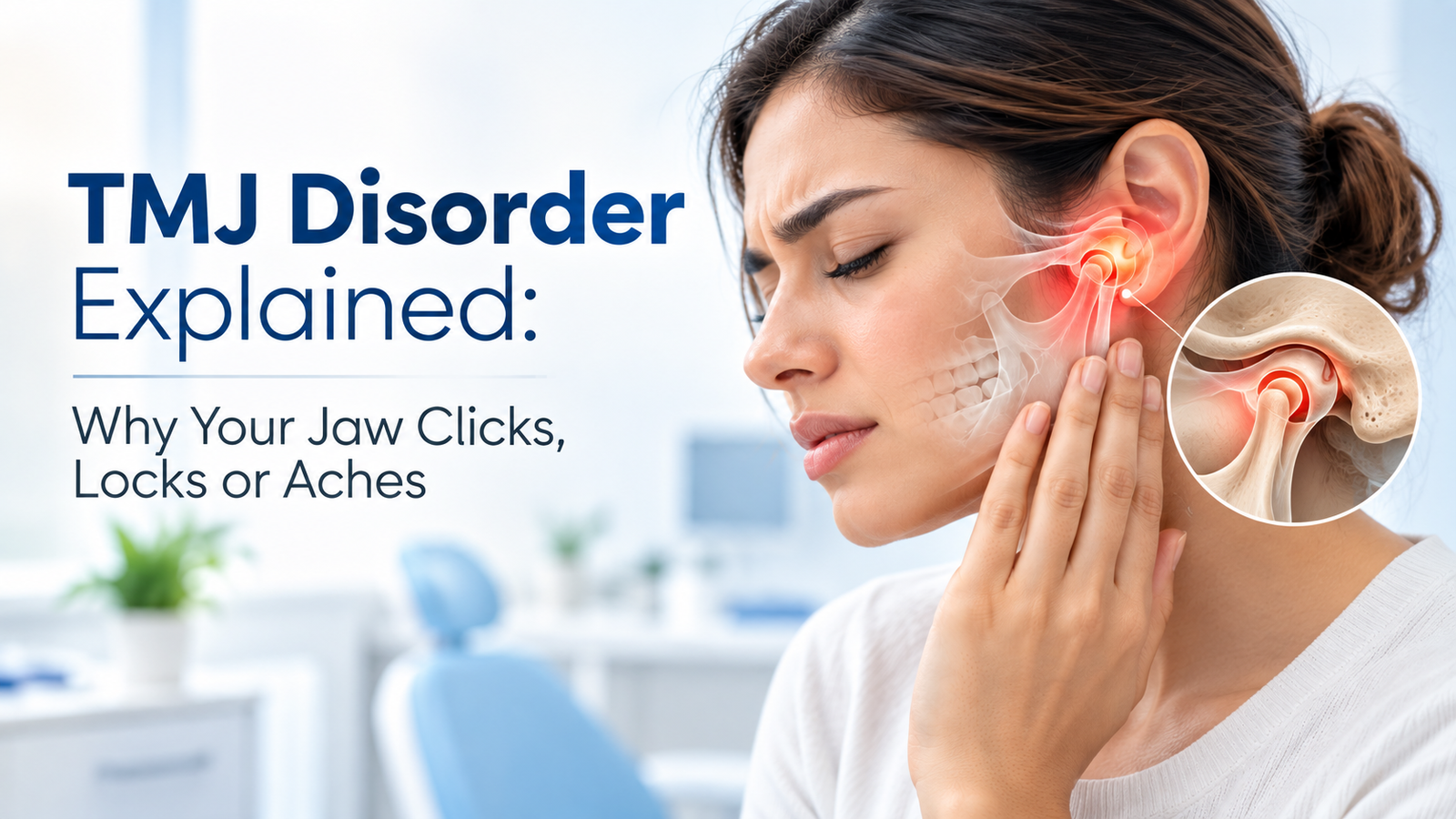
A jaw that clicks, locks, feels stiff, or aches while chewing may be related to a temporomandibular disorder, commonly shortened to TMD. The temporomandibular joint, or TMJ, is the joint just in front of each ear that connects the lower jaw to the skull. TMD is the broader term for conditions affecting this joint, the chewing muscles, or both.
Not every jaw sound means something is wrong. Painless clicking or popping is common and often does not need treatment. However, painful clicking, repeated locking, difficulty opening the mouth, or pain that affects eating, speaking, sleep, or daily activities should be assessed. The cause can differ from one person to another, so treatment should be based on an examination rather than on the sound alone.
What is TMJ disorder?
TMJ disorder is a common informal name for temporomandibular disorders, or TMDs. These are conditions involving the jaw joints, chewing muscles, and nearby tissues. A person may have a joint-related problem, a muscle-related problem, or both.
Each TMJ contains a small disc that helps the lower jaw move smoothly. Changes in how the disc and joint move can produce clicking, catching, or locking. Muscle overuse, clenching, injury, arthritis, and other factors may also contribute to pain or stiffness.
Why does my jaw click or pop?
A clicking or popping jaw often happens because the cushioning disc inside the TMJ moves slightly out of its usual position and then returns during jaw movement. This is commonly called disc displacement with reduction. It can produce a clear click as the mouth opens or closes.
A painless click by itself is not automatically a disease. The National Institute of Dental and Craniofacial Research notes that TMJ sounds without pain are common and usually do not require treatment. A click becomes more important when it is accompanied by pain, tenderness, limited movement, catching, or locking.
Jaw sounds: when are they more concerning?
| What you notice | What it may mean |
| Painless click or pop with normal movement | Often a common joint sound and may not need treatment. |
| Clicking with pain or tenderness | May suggest symptomatic TMD if it persists. |
| Jaw catches briefly and then releases | May be related to altered disc or joint movement. |
| Jaw locks and opening becomes limited | Needs prompt assessment, especially if eating is affected. |
| Grinding or grating sensation | May occur with joint surface changes, but examination is needed. |
Why does the jaw lock or feel stuck?
Jaw locking means the mouth temporarily or persistently cannot open or close normally. A closed lock, where opening becomes restricted, can happen when the joint disc no longer returns to its usual position during opening. This may cause pain and a noticeable reduction in mouth opening.
Locking can also have other causes, including muscle spasm, inflammation, or injury. If the jaw becomes stuck, opening suddenly becomes much more limited, or you cannot eat or drink normally, do not force the jaw open. Arrange prompt professional assessment.
Why does the jaw ache?
Jaw pain can come from the joint, chewing muscles, or both. It may feel like an ache near the ear or temples and may worsen with chewing, yawning, talking, or clenching.
Factors that may contribute to TMD symptoms include:
- Teeth clenching or grinding that overloads the jaw muscles
- Frequent gum chewing, nail biting, or other repetitive jaw habits
- Previous injury to the jaw, face, or joint
- Inflammatory or degenerative joint conditions such as arthritis
- Changes in the movement or position of the TMJ disc
- Muscle tension, poor sleep, and stress that may increase clenching or pain sensitivity
TMD is often multifactorial, so there may not be one single cause. A careful history and examination are more useful than assuming every painful jaw has the same problem.
What are common symptoms of TMD?
- Pain or tenderness around the jaw joint or chewing muscles
- Pain that spreads toward the cheek, temple, ear, face, or neck
- Painful clicking, popping, or grinding during jaw movement
- Jaw stiffness or tiredness, especially after chewing
- Difficulty opening the mouth fully
- Jaw catching or locking
- Headache around the temple area
- A feeling that the bite fits differently than usual
Ear fullness, ringing, or dizziness can occur in some people with TMD, but these symptoms can also have non-dental causes and should not automatically be blamed on the jaw.
How is a TMJ problem diagnosed?
There is no single test that diagnoses every TMD. Diagnosis usually starts with a detailed history and clinical examination. Your dentist may ask when the pain started, what triggers it, whether the jaw locks, whether you clench or grind, and how the problem affects eating or sleep.
The examination may include checking mouth opening, joint and muscle tenderness, jaw sounds, tooth wear, and other dental causes of pain. Imaging is not required for every patient. X-rays or CT can assess bone, while MRI can show the TMJ disc and soft tissues when clinically indicated.
How is TMJ disorder treated?
Treatment depends on the type of TMD, how long symptoms have been present, and how much they affect daily life. Many cases improve with conservative, reversible care. Permanent bite changes or surgery are not usually the first step for routine jaw clicking or uncomplicated TMD pain.Patients seeking professional evaluation can explore TMJ disorder treatment in Bangalore at Amaya Dental.
1. Self-care and activity modification
During a painful flare, softer foods and less chewing can reduce strain. Avoiding gum, very wide yawning, nail biting, and repeated testing of the jaw click may also help. Heat or cold can be used according to comfort, together with gentle jaw relaxation.
2. Pain relief
Over-the-counter pain medicines may help some people, but they are not suitable for everyone. Safety depends on your health history, pregnancy status, and other medicines. Ask a doctor, dentist, or pharmacist if you are unsure.
3. Physiotherapy and jaw exercises
A dentist or physiotherapist familiar with TMD may recommend gentle exercises, posture advice, controlled movement, stretching, or manual therapy. Exercises should be individualized. Aggressive stretching or forcing a locked jaw can make symptoms worse. A proper diagnosis helps determine suitable TMJ treatment options based on individual symptoms.
4. Oral appliances or splints
For selected patients, a dentist may recommend a stabilization splint or nightguard. It can protect teeth from grinding and may help some symptoms, although evidence for TMD pain relief varies. It should not be used to permanently change the bite as routine first-line care.
5. Specialist treatment
Persistent, severe, or clearly joint-related problems may need specialist evaluation. Depending on the diagnosis, care can include pain management, selected injections, or joint procedures. Surgery is generally reserved for carefully selected cases, not for an uncomplicated painless click.
What can you do at home for a sore or clicking jaw?
- Keep the jaw relaxed when you are not eating. The teeth do not need to stay clenched together.
- Choose softer foods for a few days during a flare, then return gradually to normal chewing as comfortable.
- Avoid gum and very hard or chewy foods while the jaw is painful.
- Avoid opening extremely wide when yawning or taking large bites.
- Use a wrapped warm or cold pack if it feels soothing.
- Notice clenching during concentration, driving, exercise, or screen time and consciously relax the jaw.
- Prioritize sleep and stress management if tension seems to worsen symptoms.
When should you see a dentist for jaw clicking or pain?
Book a dental evaluation if symptoms keep returning, interfere with chewing or sleep, or are becoming more frequent. Assessment is particularly important when the jaw locks, mouth opening is reduced, or pain follows an injury.
Seek prompt or urgent medical or dental care if:
- The jaw becomes stuck open or closed
- You cannot eat or drink because the mouth will not open properly
- There is significant facial swelling, fever, or a possible dental infection
- Pain started after a significant blow or facial injury
- There is new numbness, weakness, or another neurological symptom
- Jaw pain occurs with chest pressure, shortness of breath, sweating, or other symptoms of a possible medical emergency
TMJ assessment at Amaya Dental in Bengaluru
Amaya Dental lists TMJ disorder care among its services and has clinics in Vasanth Nagar and Sahakar Nagar, Bengaluru. Its specialist page identifies Dr. Khushboo Mishra as a prosthodontist and TMJ specialist. Assessment should focus on the cause of symptoms, not the sound alone.
If you have persistent jaw pain, painful clicking, repeated locking, or difficulty opening your mouth, you can book an appointment with Amaya Dental for an examination. You can also review Amaya Dental’s specialist information before your visit. You can also discuss your symptoms during a TMJ disorder treatment consultation with the dental team.
The bottom line
A clicking jaw is not automatically a reason to worry. Painless clicks are common, and many TMD symptoms improve with conservative measures. Pain, repeated locking, reduced mouth opening, worsening function, or symptoms that keep returning deserve more attention.
Because jaw pain can come from the joint, muscles, teeth, or another medical condition, a proper examination is the best next step when symptoms are persistent or disruptive. Treatment should follow the diagnosis, with reversible and least-invasive options generally considered before more complex procedures.
Frequently Asked Questions About TMJ Disorder
Jaw clicking can occur with TMD, but a painless click on its own is common and often does not need treatment. Assessment is more important when the click is painful, the jaw locks, movement is limited, or symptoms affect eating.
Many TMD symptoms improve with time and conservative care. The course varies depending on whether the problem mainly involves the muscles, the joint, or both. Persistent or worsening symptoms should be evaluated.
Stress is not the only cause of TMD, but it may increase clenching, muscle tension, poor sleep, or pain sensitivity. For some people, managing stress is one useful part of a broader treatment plan.
Teeth grinding or clenching can overload the chewing muscles and may contribute to jaw soreness, headaches, or tooth wear. However, not everyone who grinds develops TMD.
A nightguard may help selected patients, especially when grinding or clenching is present, but it is not a universal cure. It should be assessed and fitted appropriately by a dentist.
Repeated locking should be assessed. It may be associated with altered joint-disc movement, muscle problems, inflammation, or another joint condition. A clinician may decide whether imaging or specialist care is needed.
Not always. Many TMD problems can be assessed from the history and examination. MRI may be useful when detailed information about the joint disc or soft tissues is needed, especially with persistent locking or significant limitations.