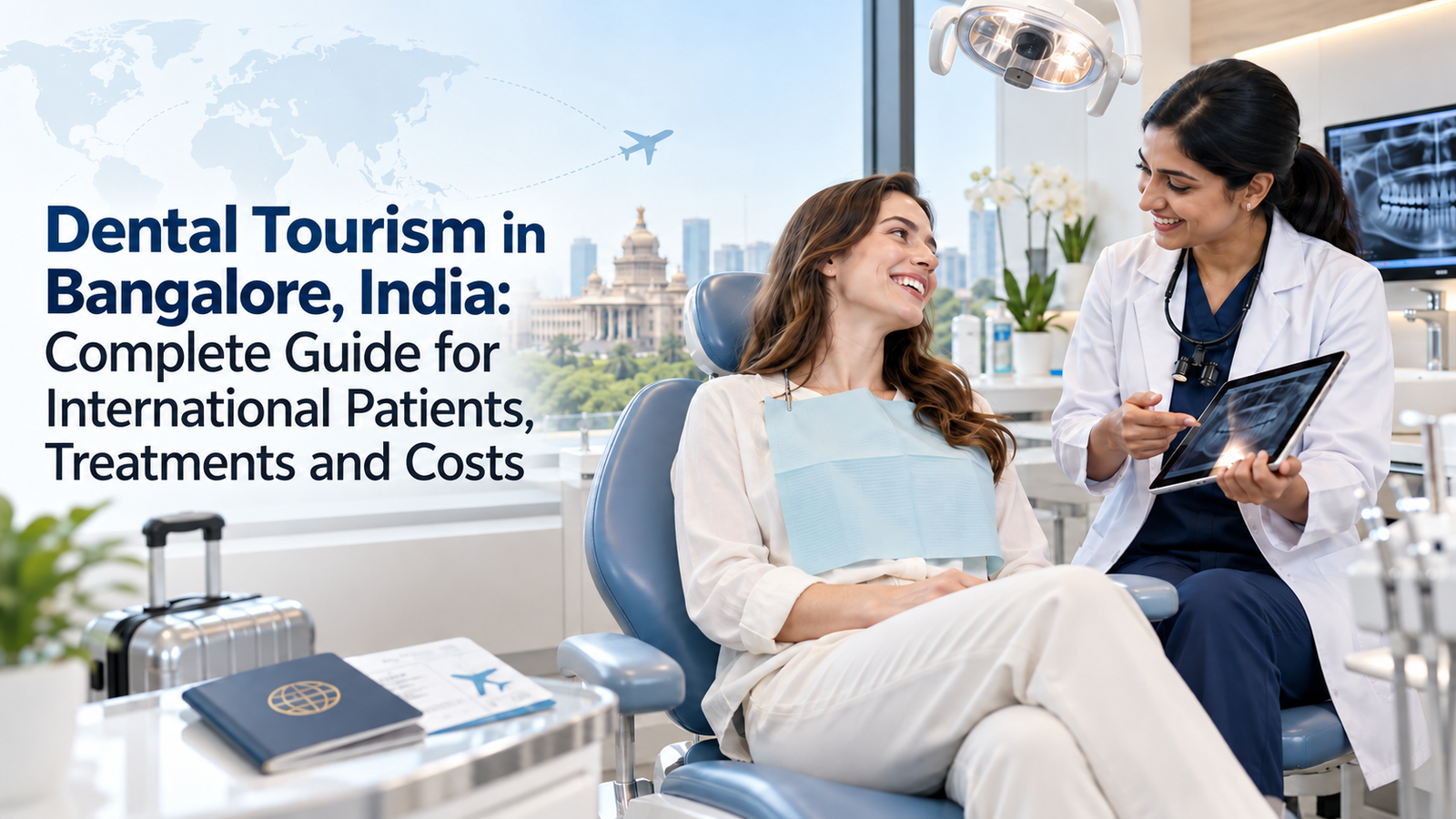
Dental tourism in Bangalore means travelling to the city for planned dental care, often because treatment costs can be lower than at home or because the patient is already visiting family. It can work well for treatments that fit a short stay, such as cleaning, fillings, whitening or a root canal. It needs more planning for treatments with several stages, such as dental implants or Invisalign.
Whether it is the right choice depends on your dental condition, the number of visits your treatment needs, and whether you can get follow-up care when you return home. This guide explains the common treatments, estimated costs, safety checks, visa and travel basics, and how to plan a trip around your dental care.
Dental Tourism in Bangalore: Why Patients Choose the City
Dental tourism is travelling to another city or country to receive dental treatment, usually planned in advance.
Patients choose to travel for several reasons. Some want treatment at a lower cost than in their home country. Others face long waiting times, or they are already travelling to India to see relatives and want to use the time well.
Bangalore suits many travellers for practical reasons. It is a large, well-connected city with an international airport, and English is widely used in clinical settings. Dental clinics here offer a broad range of treatments, from routine care to implants and clear aligners.
Lower cost is only one part of the decision. A good outcome also depends on a thorough examination, a clear written plan and sensible follow-up.
Dental tourism is not one single product. At one end, a patient living abroad books a cleaning and a filling during a family visit. At the other end, a patient plans a multi-stage treatment such as implants and builds a whole trip schedule around it. The phrase covers both, and the right approach differs. For short, routine care, the main questions are price, convenience and trust in the clinic. For complex care, the main questions are timing, healing, follow-up and who is responsible if something needs attention after you leave. Many patients also combine treatment with leisure or family time, which can be a sensible use of a trip as long as treatment dates are not squeezed around sightseeing. A useful starting point is to write down what you want to fix, how many days you can spend, and what you would do if a second visit were needed. Those three answers usually show whether travelling for care suits your situation.
People who travel for dental care usually fall into a few groups. Some are non-resident Indians visiting family who use the trip to complete pending treatment. Others are international patients who have researched options online and plan a dedicated visit. Each group has different needs: a visitor on a two-week family trip may prefer a short, focused plan, while a patient planning a dedicated stay can consider staged treatment. It helps to decide early what you want from the trip, such as pain relief, a cosmetic change or replacement of a missing tooth, because the goal shapes how many visits are needed. A clinic should be able to explain the options, including the choice to wait, and should not rush you into extensive treatment before examining you.
Is dental tourism in India safe?
Dental tourism in India can be safe when you choose a clinic carefully, have a proper examination before treatment, and match the treatment to the time you can stay. Most problems come from rushed plans, unclear communication or poor follow-up, not from the country itself.
Dental care involves instruments that touch blood and saliva, so infection control matters. The US Centers for Disease Control and Prevention publishes infection prevention guidance for dental settings, covering hand hygiene, instrument sterilization and single-use items. It is a useful benchmark for the questions you ask any clinic, anywhere.
Before booking, you can reasonably ask a clinic:
- Who will examine me, and what are their qualifications?
- Will I get a written treatment plan and cost estimate before treatment begins?
- How are instruments sterilized, and which items are single-use?
- What happens if I have a problem after I return home?
- Can I receive copies of my X-rays and treatment records?
Amaya Dental states that its clinics follow strict sterilization and hygiene protocols aligned with Ministry of Health and Family Welfare guidelines, and that clinical decisions are made after a detailed oral examination and, when needed, X-rays or scans. Ask any clinic you consider to explain its own protocols in the same way.
Safety in dentistry is mostly about process. A safe visit starts with a proper history and examination, includes clear consent for each procedure, and ends with aftercare instructions you understand. Good clinics welcome questions and do not rush the consultation. It also helps to share your full medical history honestly, including medicines, allergies, previous reactions to anaesthesia and any heart, blood sugar or bleeding concerns, because these can change how treatment is planned. If a clinic is reluctant to answer basic questions about sterilization, qualifications or follow-up, treat that as a signal to look elsewhere. You can also ask to see the treatment room and how instruments are prepared. Remember that no country or clinic can remove all risk from dental treatment. The goal is to reduce avoidable risk through preparation, communication and realistic planning.
Beyond hygiene, safety includes diagnosis and communication. A dentist should examine your mouth, review X-rays and explain findings in language you understand before suggesting treatment. You should know the proposed procedure, the alternatives, the common risks and the likely number of visits before you agree. Medication safety matters too. Tell the team about allergies, regular medicines and conditions such as diabetes, heart disease or bleeding disorders, since these can affect anaesthesia, healing and prescriptions. Ask for prescriptions and aftercare instructions in writing, and keep a copy of your records. If you need care at home later, your local dentist can use them to understand what was done.
Dental Treatments Suited to International Patients
Treatments that need one or two visits usually fit a short trip best, while staged treatments need a longer plan. Your dentist will confirm what applies to you after an examination. The table below is a general guide.
| Treatment | Typical pattern | Fit for a short trip |
|---|---|---|
| Dental cleaning (oral prophylaxis) | Usually one visit | Often suitable |
| Fillings and restorations | Often one visit, depending on the number of teeth | Often suitable |
| Teeth whitening | Often one session, sometimes more depending on the method | Often suitable |
| Root canal treatment | One or two visits, then a permanent filling or crown | Usually possible with a stay of several days or more, depending on the tooth |
| Wisdom tooth removal (disimpaction) | One procedure plus a review | Plan recovery days before flying, and ask your dentist |
| Dental implants | Several stages with healing time between them | Needs a staged plan |
| Invisalign | Months of aligner wear with periodic reviews | Needs a plan for follow-up reviews |
Treatments that often fit one trip
Cleaning, fillings and whitening are usually quick. A root canal can often be started and completed within a single trip, although some teeth need a second visit or a crown afterwards. Root canal treatment commonly takes around 60 to 90 minutes per appointment, but this varies with the tooth and the extent of infection.
Amaya Dental offers microscopic root canal treatment, which uses magnification to improve precision. Whether it suits your tooth is something the dentist decides after examining you.
If you are choosing treatments for a single trip, ask the dentist to sequence them sensibly. Cleaning is often done first so the dentist can see the teeth and gums clearly. Fillings and root canal work follow, and cosmetic treatment such as whitening is often left until the end, once the gums are healthy and any decay has been treated. Teeth can feel sensitive after some procedures, so it helps to avoid scheduling the most demanding appointment on your last day. Ask what you should expect afterwards, such as numbness for a few hours, mild soreness or temporary sensitivity, and which signs mean you should call the clinic. Keep the written summary of what was done so your home dentist can continue care.
Short procedures are easier to fit around a work trip or family visit, but they still need a proper assessment. A cleaning can reveal gum problems that need further visits, and a filling may turn out to be a larger restoration once decay is examined. Ask the dentist what could change the plan after examination so you can keep a flexible return date. If you are combining treatments, ask whether they can be scheduled on separate days to avoid long sessions. Whitening is usually planned after teeth are cleaned and decay is treated, so the order of appointments matters. Mention any tooth sensitivity, as the dentist may adjust the approach.
Treatments that need a longer plan
Dental implants involve placing a titanium post in the jawbone, waiting for the bone to heal around it, and then attaching the tooth. NHS patient information describes the overall process as taking from about six months to over a year, depending on bone quality, healing and whether bone grafts are needed. A Harvard School of Dental Medicine resource notes that single-tooth replacement often takes three to six months.
That does not mean you must stay in India for months. Some patients complete the first stage in one trip and the final stage in a second. Others arrange for their home dentist to handle the final restoration. Plan this with the clinic before the first procedure, not after.
Clear aligner treatment such as Invisalign also runs over months, with reviews along the way. Ask the clinic how reviews can be handled when you live abroad.
Staged treatments reward careful planning more than speed. In an implant case, the dentist usually needs X-rays or a 3D scan to assess the bone, and some patients need extra procedures before an implant can be placed. The healing period is not something that can be hurried safely, because the bone needs time to integrate with the implant. Smoking can slow healing, and gum disease or poorly controlled diabetes can affect outcomes, so these are discussed before treatment. For aligners, the dentist plans the movement of the teeth in stages and checks progress at set intervals. Missing reviews can affect how well the plan runs. Before committing, ask for a clear map of every stage, who performs each one, and where each will happen if you are not in Bangalore.
When you compare treatments, consider urgency as well as convenience. Pain, swelling or a broken tooth often needs prompt care, so the plan may focus on relieving the problem first and leaving elective work for later. Cosmetic treatments such as whitening are usually planned around an event or the length of your stay, and results can vary between patients. If more than one treatment is needed, the dentist may suggest an order, for example treating gum health and decay before cosmetic work, and this sequence can affect how many days you need. Bring previous dental records, and ask which parts of the plan can be completed in India and which could be finished by your home dentist.
For staged treatment, the key question is what happens between stages. After an implant is placed, the bone needs time to integrate with it, and your dentist will advise when the next step can happen. During this period you may be given a temporary solution, or you may wait with a gap, so ask how it will look and how you will eat. For aligners, ask how often reviews are needed and whether some can be done with photographs and remote check-ins, subject to the dentist’s judgement. Also ask who takes responsibility if a problem appears while you are abroad. Splitting treatment between Bangalore and your home dentist is possible, but both dentists should agree on the plan before it starts.
How much does dental treatment cost in Bangalore?
Approximate treatment costs at Amaya Dental range from ₹1,500 for a simple filling to ₹3,40,000 for a full Invisalign case. These are estimates only. The final cost depends on your dental condition, treatment complexity, the materials used and your personalized treatment plan.
| Treatment | Estimated cost range (INR) |
|---|---|
| Invisalign | ₹1,50,000 to ₹3,40,000 |
| Dental implants | Starting from ₹30,000 (can go up to ₹70,000 depending on case requirements) |
| Root canal treatment | ₹4,500 to ₹8,500 |
| Oral prophylaxis (dental cleaning) | ₹2,000 to ₹6,500 |
| Teeth whitening | ₹9,000 to ₹25,000 |
| Disimpaction | ₹4,500 to ₹15,000 |
| Dental restoration or filling | ₹1,500 to ₹9,500 |
Factors That Affect the Final Estimate
- The number of teeth or implants involved
- Whether extra procedures are needed, such as a bone graft, an extraction or a crown
- The materials chosen for restorations
- The complexity of the tooth anatomy or the bite
- The number of visits and follow-up reviews
Some of these factors are visible at the first consultation, while others only appear during treatment. A tooth that looked simple on an X-ray may turn out to have a crack or extra canals, and a planned filling may need to become a larger restoration. This is normal in dentistry, and a transparent clinic explains it before going ahead rather than after. Ask the dentist to tell you in advance when the plan changes and what the new cost would be, and to wait for your agreement. Materials also matter. Different restorative materials and brands carry different costs and properties, and your dentist can explain the trade-offs between durability, appearance and price for your particular tooth.
Dentists look at several things before giving a figure. Tooth condition comes first: a tooth with deep decay or infection may need more steps than one with early damage. Bone quality and gum health matter for implants, and may mean extra preparation such as treating gum disease first. For aligners, the amount of tooth movement needed influences the length of treatment and the number of aligners. Materials also vary, for instance in the type of crown or filling chosen, and some options last longer or look more natural than others. Your own priorities count too, since you may prefer a simple functional repair or a more aesthetic result. Ask the dentist to explain why each item is needed.
Comparing Costs with Your Home Country
Compare the full cost of the plan, not only the treatment line. Add flights, accommodation, the days you will be away from work, and the cost of any follow-up at home. For multi-stage treatment, a second trip may change the comparison. A written estimate from the clinic after examination is the only reliable basis, so international patients are encouraged to consult Amaya Dental for an accurate evaluation and a customized treatment estimate.
A simple way to compare is to build a total-cost list for each option. For treatment in Bangalore, list the treatment estimate, flights, accommodation for the number of days needed, local transport, meals, travel insurance and time away from work. For treatment at home, list the treatment estimate, any waiting time, and time off work. Then add a line for the cost of a possible second visit or follow-up appointment. Include any extra cost of fixing a problem if it occurs. This does not make the decision for you, but it shows whether the saving remains once everything is counted. For small treatments, the trip itself may cost more than the dental work, so travelling mainly for a filling or a cleaning rarely makes financial sense.
When reading any estimate, ask what it includes. A quote may cover only the main procedure, or it may also include consultation, X-rays, anaesthesia, medicines, temporary restorations and review visits. For implants, ask whether the figure covers the post, the abutment and the crown, and whether bone grafting would be charged separately. For Invisalign, ask how refinements, retainers and review appointments are handled. Ask about payment timing and what happens if the plan changes after examination. A written estimate that lists each item makes comparison with a quote from your home country far easier. The ranges above are approximate and can only be confirmed after an examination.
A fair comparison uses the same scope on both sides. If a home-country quote includes a consultation, X-rays and a crown but the Bangalore estimate lists only the implant post, the two are not comparable, so ask both clinics to itemise. Then add travel costs, accommodation for the days you need, meals, local transport and any time off work. If treatment is staged, count a second trip or the cost of finishing at home. Exchange rates can also move the final figure, so check the rate close to the date you pay. Consider quality and follow-up as well as price: a slightly higher estimate with clear aftercare may suit you better than the lowest figure.
How long should I stay in Bangalore for dental treatment?
The length of stay depends on the treatment, commonly a few days for a cleaning, filling or root canal and longer for staged treatments. Your dentist can give a realistic estimate after reviewing your X-rays and dental history.
- Ask whether any buffer days are needed for healing or for a review before you fly.
- Allow extra time if more than one treatment is planned.
- After wisdom tooth removal or other surgery, ask your dentist when it is safe to fly.
- Avoid booking a flight on the same day as a procedure.
Stay length is easier to plan when you know your dentist’s schedule. Ask the clinic to propose a day-by-day plan after reviewing your records, and ask which appointments depend on healing between visits. A root canal followed by a crown, for example, may need an interval before the crown is fitted. Wisdom tooth removal may need a review a few days later, such as to check healing or to remove stitches that are not dissolvable. If you are travelling with family, share the plan with them so they can adjust their own schedule. Keep one or two spare days in your plan, because a delayed appointment or a flight change is easier to absorb when you have flexibility.
A practical approach is to build the stay around the longest single step in your plan, then add buffer days. If a root canal needs two visits a few days apart, that sets the minimum. Cleaning or whitening can often be scheduled on separate days to keep appointments comfortable. For staged treatment, ask the dentist which stages must happen in person and which may be reviewed remotely with photographs, subject to the dentist’s judgement. Jet lag can make a long first appointment tiring, so consider booking the first visit a day after you arrive. If your visa has a fixed validity, check that your planned dates sit comfortably inside it.
Checklist for Choosing a Dental Clinic Abroad
Check the dentists’ qualifications, the clinic’s hygiene practices, how the treatment plan is communicated, and what follow-up is offered. A clinic that explains options plainly and does not pressure you is a better sign than a heavily discounted package.
- Qualifications: Are the dentists and specialists named, with their credentials listed? Amaya Dental lists its team on its specialists page.
- Written plan: Do you receive a clear diagnosis, treatment options, stages and an estimate in writing?
- Records: Will you receive X-rays, photographs and a treatment summary to take home?
- Hygiene: Does the clinic describe its sterilization process openly?
- Aftercare: What happens if you have pain, swelling or a loose restoration after you leave?
- Communication: Can you reach the team by phone or WhatsApp before and after the trip?
- Honest limits: Does the dentist explain what a treatment cannot do, not only what it can?
Be cautious of any clinic that promises guaranteed results, asks for full payment far in advance, or recommends extensive treatment without examining you.
Reviews and photographs can help, but read them with care. Look for patterns in what patients say about communication, waiting time, explanation of options and follow-up, rather than relying on a single glowing or negative comment. Before and after photographs show results for individual patients and cannot predict your own outcome. It is reasonable to ask the clinic how it handles complaints and whether it can put you in touch with your home dentist to share records. Finally, trust your impression of the consultation. If you feel rushed, confused or pressured to decide on the spot, you can ask for time, request the plan in writing, and consider a second opinion before agreeing to anything.
Online reviews can help, but read them with care. Look for patterns across many reviews rather than one glowing or critical comment, and notice whether reviewers describe clear explanations, follow-up and the handling of problems. Check that the clinic’s website matches what the team tells you, including addresses, doctors and services. A clinic with a verifiable address, named dentists and a direct phone number is easier to reach than one that only uses a web form. Ask for a video call or a written consultation before you travel so you can judge how the team communicates. If something feels rushed or vague before you travel, it is unlikely to improve afterwards.
Do I need a visa for dental treatment in India?
Most international visitors need a visa to enter India, and travellers coming for treatment may be eligible for a medical visa category. Rules, eligibility by nationality, validity and attendant provisions can change, so check the official Indian visa portal before you book.
- Which visa category applies to your nationality and purpose
- Which supporting documents are required, such as a letter from the treating clinic
- Whether family members travelling with you qualify for an attendant visa
- Registration or extension requirements once you are in India
- The conditions printed on your visa or e-Visa grant override any summary you read elsewhere, including this one.
Start the visa check early, since you may need supporting documents from the clinic and processing times can vary. Many clinics can provide a letter confirming the planned treatment, but they cannot decide your visa. Check that your passport has enough validity for your travel dates and that the name on every document matches. If someone will travel with you, confirm in advance what category they can apply under and whether their application depends on yours. Keep digital and printed copies of your visa, passport, appointment confirmations and treatment letter while you travel. Airlines and immigration rules can change, so confirm requirements close to your departure date, and rely on official government sources rather than third-party summaries.
Allow time for the visa process before booking non-refundable flights. Processing time and requirements can differ by nationality, and incomplete applications are a common cause of delay. Keep your passport valid for the period the rules require, and keep digital and printed copies of your visa, the clinic’s appointment confirmation and any consultation letter. If a family member travels with you, check whether they need a separate category. Once you are in India, ask whether any registration or extension steps apply to your visa type. Read your travel insurance carefully, since planned dental treatment may be excluded. If anything is unclear, the official portal or your nearest Indian mission is the reliable source.
Preparing for Your Dental Trip Step by Step
Start with a remote consultation and your existing records, then confirm the plan in writing before you book travel.
Good preparation keeps the trip calm and the treatment on track. The idea is to settle the big questions before you fly, so that the days in Bangalore are used for treatment and recovery rather than for planning. That means agreeing to a provisional plan, understanding what could change it, and knowing who to contact at each stage. It also means thinking about your return. Your home dentist can help by providing recent records and, if you are happy to share them, by agreeing in advance to review the treated area. This does not need to be complicated. A short checklist and a few clear conversations are enough for most patients, and they make it easier to handle the unexpected if it happens.
Before you travel
- Share recent dental X-rays, photographs and your dental history with the clinic.
- List your medical conditions, regular medicines and allergies. Conditions such as diabetes or blood-thinning medicines can affect dental treatment, so the dentist needs to know.
- Ask for a provisional plan, the likely number of visits and an estimate range.
- Book flexible flights if the plan could change after the in-person examination.
Gather your documents in one folder, on paper and on your phone. Include recent X-rays or scans, a short summary of past dental treatment, a list of your current medicines with doses, and your allergy information. If you have a medical condition, ask your doctor whether anything should be considered before dental treatment and bring any advice in writing. Check your travel insurance and ask whether it covers planned dental work or only emergencies. Confirm payment methods with the clinic, and find out whether you will receive an itemised receipt you can use for any claim. Finally, tell the clinic about any dates you cannot change, so the plan can be built around them.
Start the process a few weeks ahead if you can, so you have time for a remote consultation, questions and visa steps. Ask the clinic what they need from you, usually X-rays, photographs of the area and a medical history. If you have had recent dental work at home, bring the records so tests are not repeated. Check that your health and travel insurance cover what you need. Arrange for a trusted person at home to hold copies of your documents. Finally, agree with the clinic in writing how many visits to expect, the likely date range and how the estimate will be confirmed after examination.
During your stay
- Expect a full examination, usually with X-rays, before any treatment is confirmed.
- Ask the dentist to explain alternatives, including doing nothing for now.
- Keep copies of your treatment notes, medicines prescribed and aftercare instructions.
- Attend any review appointments before you fly home.
Keep your daily routine gentle after treatment. After procedures that use local anaesthesia, avoid chewing on the numb side until feeling returns, to prevent biting your cheek or tongue. Follow the dentist’s advice on food, brushing around the treated area, and pain relief. Do not stop or start medicines without asking. Take photographs of any swelling or concern and note when it began, since this helps if you need to contact the clinic later. Drink enough water, rest when you need to, and avoid planning demanding activities straight after a longer appointment. If you feel unwell, tell the team promptly instead of waiting for your next scheduled visit.
Keep the first appointment simple. Let the dentist examine you, review X-rays and explain options before any treatment begins. Take notes or ask for a written summary, and confirm the plan for the days ahead. If you feel pain, anxiety or doubt, say so, because a good team will pause and explain. Follow the aftercare advice, including food, brushing around the treated area and medicines. Save receipts, prescriptions and the clinic’s contact details in one place. Allow some rest between appointments, especially after longer procedures. Before your last visit, confirm that you have your records, X-ray copies and written aftercare instructions, and that you know what to do if a problem appears after you fly.
After you return home
- Follow the aftercare instructions carefully.
- Tell your home dentist about the treatment, and share your records.
- Contact the clinic promptly if something feels wrong. Do not wait for it to settle.
- Keep up regular check-ups, particularly after implants or crowns.
The weeks after you return are part of the treatment. Keep the written aftercare plan somewhere easy to find and follow it as written. Book a check-up with your home dentist, share the records you brought back, and mention any change in how a tooth or restoration feels. Mild sensitivity or soreness can be expected after some procedures, but increasing pain, swelling, a bad taste, fever or a restoration that feels loose are reasons to seek advice promptly. Contact the treating clinic and your local dentist, and describe what you notice with dates and photographs if possible. Good oral hygiene, regular check-ups and, where relevant, cleaning around implants or aligners all protect the work that was done.
Pack a small dental folder. Include recent X-rays or scans, a list of your medicines and allergies, the contact details of your home dentist and your insurance details. Arrive with a short list of questions and your main goal written down, so the first consultation stays focused. Ask whether you can travel on your own after a procedure that uses anaesthesia. Plan a quiet day after surgical treatment, and keep soft foods and any prescribed medicines within easy reach. Having a family member or friend with you can help with transport and with remembering instructions.
The weeks after treatment are when many questions appear. Mild soreness or sensitivity can be part of normal healing, but severe pain, swelling that spreads, fever, bleeding that does not settle, or a restoration that feels loose should be reported promptly. Contact the clinic, and your home dentist if you cannot reach them. Share your records with your home dentist and ask them to review the area at a suitable time. Keep up the cleaning routine you were advised, attend scheduled reviews, and book regular check-ups. If treatment is staged, put the next appointment dates in your calendar and confirm travel plans in good time.
Risks and Limits of Dental Tourism
The main risks are complications far from your treating dentist, rushed plans, and difficulty getting follow-up care. These are manageable with planning, but they are worth taking seriously.
- Complications after you leave. Swelling, infection or a restoration that needs adjustment can appear days or weeks later. Ask in advance how these are handled.
- Staged treatment. Implants and aligners need follow-up, which is harder from abroad.
- Compressed schedules. Too many procedures in a short stay can limit healing time and make it harder to adjust the plan.
- Insurance. Many dental plans do not cover treatment abroad, and travel insurance may not cover planned procedures. Check both.
- Cross-border redress. If you are unhappy with treatment, resolving it from another country is harder than at home.
Dental tourism is not suitable for everyone. If you have complex medical needs, a dental emergency or a problem that needs close monitoring, treatment closer to home may be the better choice. Your dentist can advise.
Risk is easier to manage when it is named early. Ask the dentist to explain the specific risks of your planned treatment in plain language, how likely they are, and what would be done if they occurred. For example, implants can fail to integrate or become inflamed around the gum, root canal treated teeth can sometimes need retreatment, and any extraction can be followed by dry socket or infection in some patients. These are not reasons to avoid treatment, but they are reasons to have a plan. Write down the clinic’s emergency contact details, the name of your treating dentist, and the name of a local dentist you could see in an urgent situation at home. Preparation of this kind turns a worrying surprise into a manageable problem.
Most people who travel for routine dental care have uneventful experiences, but it is sensible to plan for the exceptions. Before you leave, write down what you will do if you develop pain, swelling, fever or bleeding that seems more than expected. Know the clinic’s contact number and whether an emergency line exists. Keep your home dentist informed so they can see you quickly if needed. Consider whether the treatment is reversible: a filling can often be replaced, while a tooth that is removed cannot be put back. For decisions that cannot be undone, take time to reflect, ask for a second opinion if you wish, and avoid deciding under pressure from a travel schedule.
Dental Treatment at Amaya Dental, Bangalore
Amaya Dental has two clinics in Bangalore, in Vasanth Nagar (central Bangalore) and Sahakar Nagar (north Bangalore). The clinic describes a team of more than 20 qualified dental specialists and a range of services that includes dental implants, Invisalign, digital smile designing, smile makeovers, teeth whitening, laser dentistry, pediatric dentistry, microscopic root canal treatment, TMJ disorder treatment and full mouth rehabilitation.
If your goals include cosmetic changes, digital smile designing uses digital planning to help you visualize a proposed result before treatment, and teeth whitening is a common option for stains and discoloration. For tooth replacement, you can read about dental implants in Bangalore before your consultation.
Every treatment recommendation follows an examination, so no one can promise a specific plan or outcome in advance.
Choosing a clinic is a personal decision, and it is sensible to compare more than one. When you speak to Amaya Dental, you can ask the questions listed earlier in this guide: who will treat you, what the written plan and estimate include, how sterilization is handled, and how follow-up is arranged once you are back home. The team’s clinical decisions follow an examination, so any estimate before that is provisional. The two clinics, in Vasanth Nagar and Sahakar Nagar, may suit different stays depending on where you will be living in the city, so mention your accommodation area when you enquire. You can also read the clinic’s service pages beforehand, which helps you arrive with better questions and a clearer idea of your options.
If you decide to contact Amaya Dental, a few preparation steps make the first conversation more useful. Send recent X-rays or photographs of the area of concern, a short description of your goal and your intended travel dates. The team can then explain what an in-person examination would involve and which treatments are likely to be discussed. The Vasanth Nagar clinic is at 8/1, 1st Floor, Palace Road, and the Sahakar Nagar clinic is in G Block, so you can ask which location suits your accommodation. You can call +91 9591895500 or use the appointment page. As with any clinic, treatment recommendations come only after an examination.
Conclusion
Dental tourism in Bangalore can be a practical option when the treatment suits the time you have, the clinic is transparent about its plan and costs, and you have a way to handle follow-up. Simple treatments often fit one trip. Implants and aligners need more planning.
The most reliable way to decide is to take small steps. Share your records for a preliminary opinion, compare the written plan with what you could get at home, and ask honest questions about time, risk and follow-up. If the answers are clear and the plan fits your schedule, travelling for treatment may be a sound choice. If the plan feels rushed, vague or dependent on a long stay you cannot manage, it may be better to wait or choose care closer to home. Either decision is reasonable. What matters is that you understand the treatment, the cost, the timeline and the aftercare before you commit, and that you know who to call if you need help.
If you are considering care in Bangalore, share your dental history and recent X-rays with Amaya Dental for an accurate evaluation and a customized treatment estimate. You can book a consultation or call +91 9591895500.
This article is for general information and does not replace a dental examination. Treatment outcomes vary between patients.